
The BPGA (Protection and Management Box for Power Supplies) consolidates electrical distribution and fuse protection in vehicles from the Stellantis group. When a failure occurs, the symptoms often resemble each other: battery discharging, warning message on the dashboard, accessories stopping functioning. Knowing how to read this box and test its fuses allows one to distinguish a simple blown fuse from a deeper electronic failure.
Reference Voltage and Test Thresholds for the BPGA Box with a Multimeter
Before disassembling anything, the multimeter provides a reliable first reading of the circuit’s status. The measurement is taken with battery terminals connected, ignition on, engine off.
| Measurement Point | Expected Value (ignition on) | Interpretation if deviation |
|---|---|---|
| Battery Voltage (direct terminals) | About 12.4 V to 12.7 V | Below 12 V: battery discharged or faulty |
| Output Voltage from BPGA (main power wire) | Close to battery voltage | Drop greater than a few tenths of a volt: abnormal resistance in the box |
| BPGA Ground (ground terminal) | Less than 0.1 V relative to battery ground | Higher value: poor ground contact, corrosion |
| Individual Fuse (continuity mode) | Continuous sound signal (circuit closed) | No signal: fuse blown |
This table summarizes the basic checks. The logic is simple: one always compares the voltage upstream and downstream of the BPGA to locate an abnormal drop.
A point often overlooked: the BPGA ground must be checked as a priority. An oxidized terminal at the ground point is enough to cause intermittent cuts that many mistakenly attribute to the box itself.
BPGA Fuses: Identification and Testing Method Without Complete Disassembly
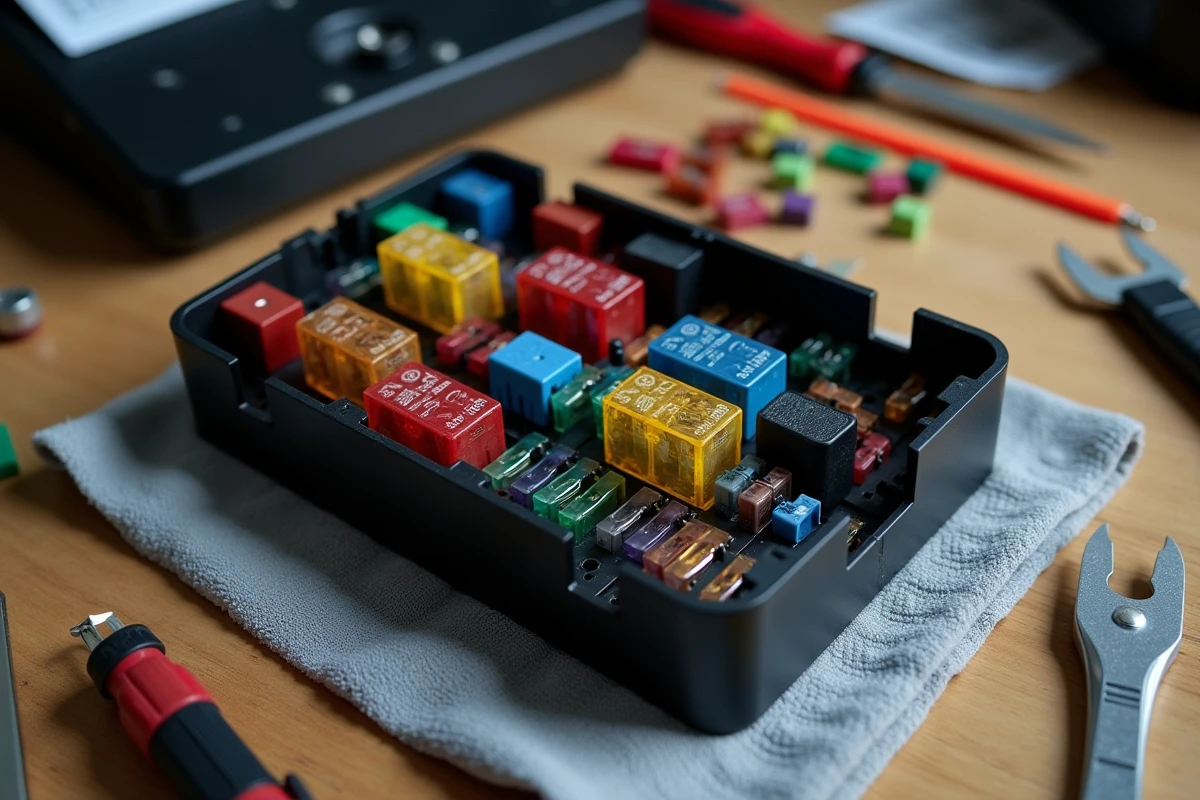
The BPGA incorporates several types of fuses and relays, organized according to the circuits they protect (lighting, ECUs, starting, air conditioning). Unlike a conventional fuse box, some fuses in the BPGA are soldered or plugged into hard-to-access slots. To find out how to test a BPGA box on Les Voitures Anciennes, one must first identify the type of fuse concerned.
Plug-in fuses (standard blade or mini type) can be tested with a multimeter in continuity mode without removing them. Simply place the probes on the two metal legs visible on the surface of the fuse.
- Standard or mini blade fuse: directly accessible, continuity test on the exposed legs. A functional fuse allows current to pass without measurable resistance.
- High-intensity cartridge fuse (male Japanese type): protects high-power circuits like the starter. Testing may sometimes require removing a plastic cover. Continuity remains the reliable method.
- Relays integrated into the BPGA: a faulty relay is not tested in the same way. One must measure the input and output voltage of the relay, then check that it switches when the circuit is activated (turning on lights, starter, etc.).
A visually intact fuse can be blown. The internal wire sometimes melts without visible trace on the transparent casing. The multimeter remains the only reliable diagnostic tool for fuses.
Electrical Symptoms Related to the BPGA and Common Diagnostic Deviations
BPGA failures rarely manifest as a single isolated symptom. The dashboard often displays a generic message such as “Electrical circuit fault” or “Battery charge fault,” which directs the diagnosis toward the battery or alternator before the BPGA is even suspected.
Intermittent cuts are the most misleading symptom. The vehicle starts normally for several days, then refuses to start for no apparent reason. This pattern points to an internal contact problem in the BPGA (cold solder, oxidized track) rather than a blown fuse.
In contrast, a clear failure (no starting, no power to accessories) leans more toward a blown main fuse or a stuck relay. The distinction is made with a multimeter: if the voltage arrives correctly at the BPGA but does not come out on a given circuit, the problem is located in the box.
Trap of Fault Code B1624
The B1624 code, common on Peugeot 308, 3008, 5008 and Citroën C4 or DS4, indicates a power management fault. This code does not always indicate a failure of the BPGA itself. A ground fault or a blown high-intensity fuse generates the same code.
Clearing the code without checking the voltages and continuity of the fuses amounts to masking the problem. The code generally reappears after a few starting cycles.

Repair or Replacement of the BPGA: What the Diagnosis Reveals
If the multimeter test shows correct voltages at the input but drops at the output on several circuits, the box itself is at fault. Two options then arise.
Targeted repair of the BPGA involves redoing faulty solder joints or replacing damaged electronic components on the internal board. This approach is gaining ground against complete replacement, as the cost of a new BPGA represents a significant expense for a part that weighs a few hundred grams.
Replacement with a new or refurbished box remains relevant when the board shows signs of advanced corrosion or burned tracks. In this case, a spot repair does not guarantee medium-term reliability.
- If only one fuse or relay is at fault: replace the component, very low cost, quick intervention.
- If the electronic board shows localized cold solder joints: specialized repair possible, correct reliability after rework.
- If corrosion affects multiple areas or if tracks are interrupted: complete box replacement recommended.
The multimeter diagnosis, conducted methodically on each output circuit of the BPGA, allows one to decide between these options without replacing a part that could have been repaired. Testing before ordering avoids the majority of unnecessary replacements.