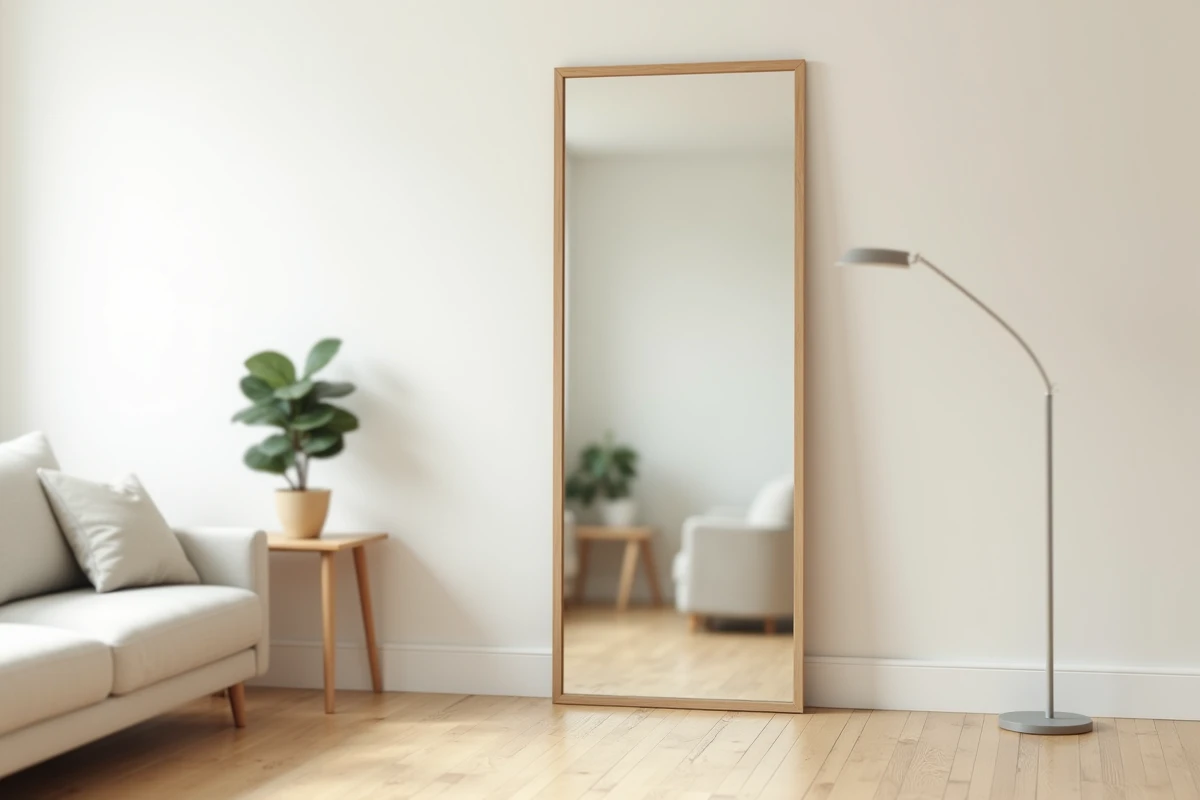
A large mirror leaning against a wall transforms a room in seconds. It enlarges the space, captures light, and adds character to a living room or bedroom. The problem arises when this mirror slips, tilts, or threatens to topple over. Stabilizing a mirror on the floor without drilling or wall mounting requires understanding what actually keeps it in place.
Friction on the floor and angle of support: the two forces that keep a mirror upright
Before looking for a miracle accessory, it’s important to understand why a floor-mounted mirror stays or doesn’t stay in place. Two parameters come into play: the friction between the base of the mirror and the flooring, and the angle of inclination against the wall.
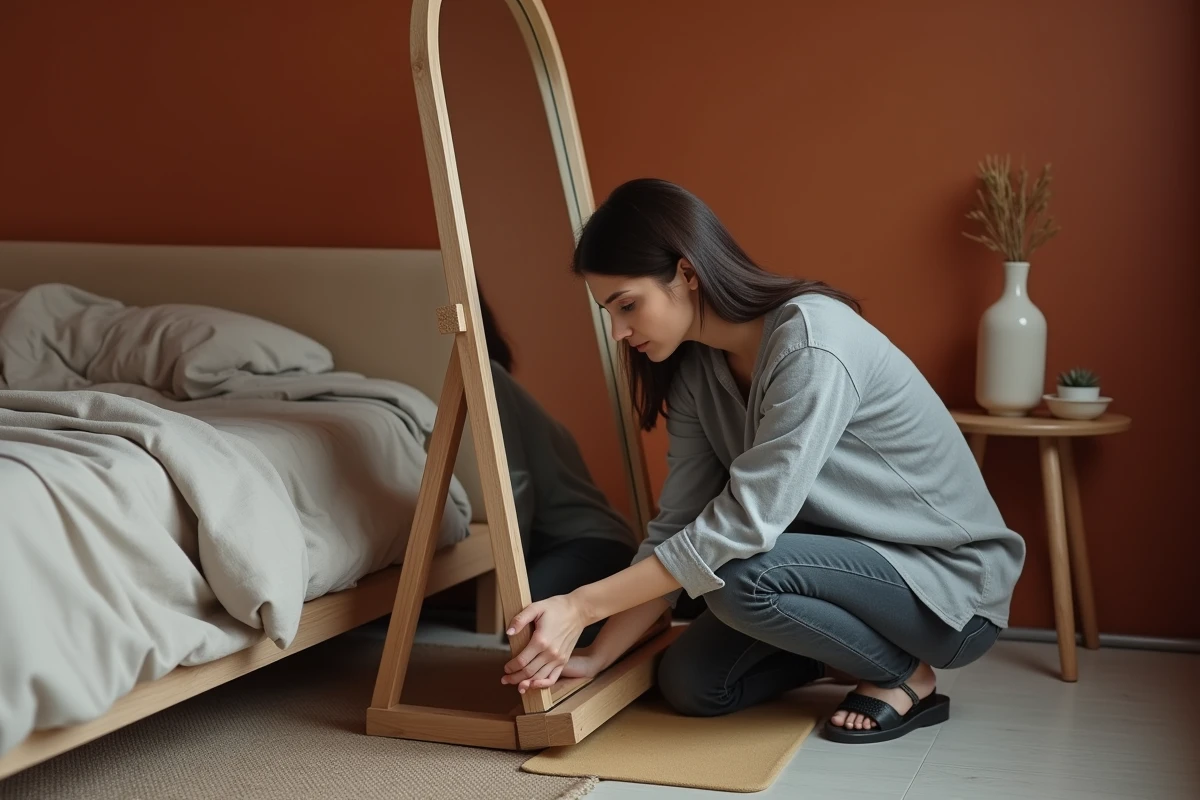
A perfectly vertical mirror against a wall has almost no lateral support. A draft, a cat, or a vibration is enough to make it tip forward. Tilting the mirror a few degrees towards the wall creates a stable triangle of forces: the weight is distributed between the floor and the point of contact with the wall.
The friction, in turn, directly depends on the couple between the floor and the base of the mirror. On smooth tiles or varnished wood, a raw wooden frame slides easily. On thick carpet, it barely moves. This is the friction that needs to be artificially increased when the floor is slippery.
Choosing the right wedge and floor mirror support makes the difference between a mirror that stays in place for months and one that slips at the first sweep of a broom.
Non-slip strips under the base of the mirror: a solution borrowed from boating
Have you ever noticed the textured coverings on a boat’s deck? These strips also exist in an indoor version. Manufacturers like 3M (Safety-Walk range, technical documentation revised in 2022) promote a repurposed use of their non-slip strips to prevent the slipping of furniture and mirrors on tiles or varnished wood.
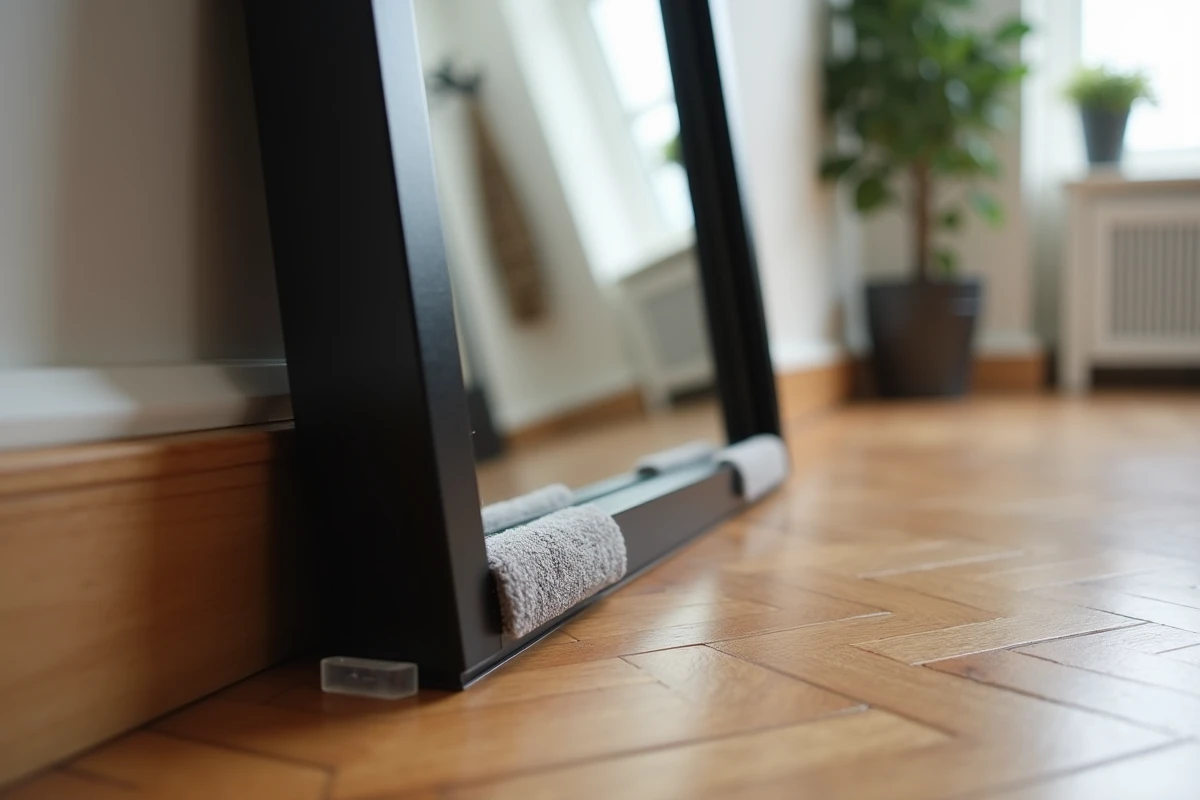
Their grip far exceeds that of traditional felt pads. The principle is simple: a strip is glued along the entire length of the base of the mirror. The textured side makes contact with the floor and creates resistance to slipping.
Concrete setup
- Clean the base of the frame and the floor with a dry cloth to remove dust and greasy residues; otherwise, the adhesive won’t hold.
- Cut the non-slip strip to the exact length of the base of the mirror, without exceeding the sides to avoid an unsightly visual effect.
- Press firmly for about thirty seconds along the entire length, then wait several hours before repositioning the mirror against the wall.
This method works particularly well on hard, smooth floors. On oiled wood, check that the adhesive doesn’t leave marks by first testing on a hidden area.
Wedges and seismic cushioning foams: blocking the mirror from below
Wooden or plastic wedges are the most intuitive solution. A small wedge is slid under the front edge of the mirror to prevent the foot from slipping forward. It’s effective but basic.
A more technical alternative exists: seismic cushioning foams. Originally developed to secure sensitive equipment in earthquake-prone areas, these foams absorb vibrations and prevent any lateral or frontal movement. Some museums use them to stabilize large frames without drilling into historic walls.
They are cut to the desired size and placed under the base of the mirror, possibly combined with angular wedges. The seismic foam absorbs everyday micro-vibrations (not in the hallway, slamming doors, washing machine upstairs) that can sometimes cause a mirror to shift several centimeters over a few weeks.
Anti-tipping strap: the safety that insurers are starting to require
Stabilizing a mirror on the floor is not just about preventing slipping. The main risk remains tipping forward, especially with large formats that exceed one meter in height.
The INRS prevention sheet on falling objects (updated 2023) recommends anti-tipping devices for all heavy vertical elements in support. French home insurers are beginning to refer to this for claims involving tall mirrors, according to the 2023 domestic risk summary from the French Insurance Federation.
A falling mirror can cause serious injuries, especially in a household with young children or pets. The anti-tipping strap attaches on one side to the back of the frame (with screws or structural adhesive) and on the other to the wall, with a simple high-strength adhesive attachment. No drilling is needed.
Choosing the right strap
Opt for braided nylon straps with a tensile strength suitable for the weight of your mirror. Models sold to secure children’s dressers and bookshelves work very well. Ensure that the adhesive wall attachment is compatible with your wall type (painted plaster, smooth concrete, wallpaper).
Combining an anti-tipping strap and non-slip strips on the floor covers both risks: slipping and tipping forward. This double safety takes only a few minutes to install and leaves no visible marks.
Natural weights and counterweights: using what you already have
There’s not always a need to buy specific equipment. Placing a stack of heavy books, a terracotta flower pot, or a weighted basket against the front base of the mirror is sometimes enough to block slipping.
This approach has the advantage of integrating into the decor. A large ceramic vase placed in front of a full-length mirror creates a visually coherent composition while serving as a stop. The counterweight must be heavy enough to resist an accidental push.
However, be cautious: a counterweight alone does not protect against tipping. If your mirror is more than one meter tall, combine this method with a strap or adhesive mounts at the back.
Stabilizing a mirror on the floor relies on a combination of precautions rather than a single solution. Non-slip strips, wedges, anti-tipping straps, and counterweights work better together than separately. A mirror that stays in place without drilling requires five minutes of preparation, not a tool budget.