
Cutting a wooden board to make a shelf, adjusting decking boards, or cutting plywood: these common DIY tasks require a reliable circular saw without needing a professional model. The Black & Decker CD601 circular saw, with its 1100 W corded motor and 170 mm blade, has been positioned in this niche for several years.
Its price remains among the most accessible on the market, but is this price enough to justify the purchase compared to more recent models?
1100 W Corded Motor and 170 mm Blade: What This Power Really Allows You to Cut
An 1100 W motor here runs at 5000 revolutions per minute. In practice, this means that the CD601 easily cuts through melamine panels, medium-thickness plywood, and softwood boards up to 55 mm deep at 90°.
Have you ever noticed that a saw struggling with hardwood produces burned and uneven cuts? With this machine, solid oak or thick beech remains doable, but you must advance slowly to avoid overheating. The motor does not have the torque reserve of a higher-end Bosch or Makita model.
The 170 mm blade size also limits possibilities. For framing pieces or lumber beyond 55 mm, you will need to switch to a larger diameter. For home DIY projects (shelves, formwork, cutting flooring), this cutting capacity covers the vast majority of needs.
To better understand its technical characteristics, you can discover the Black & Decker CD601 in detail before making your decision.
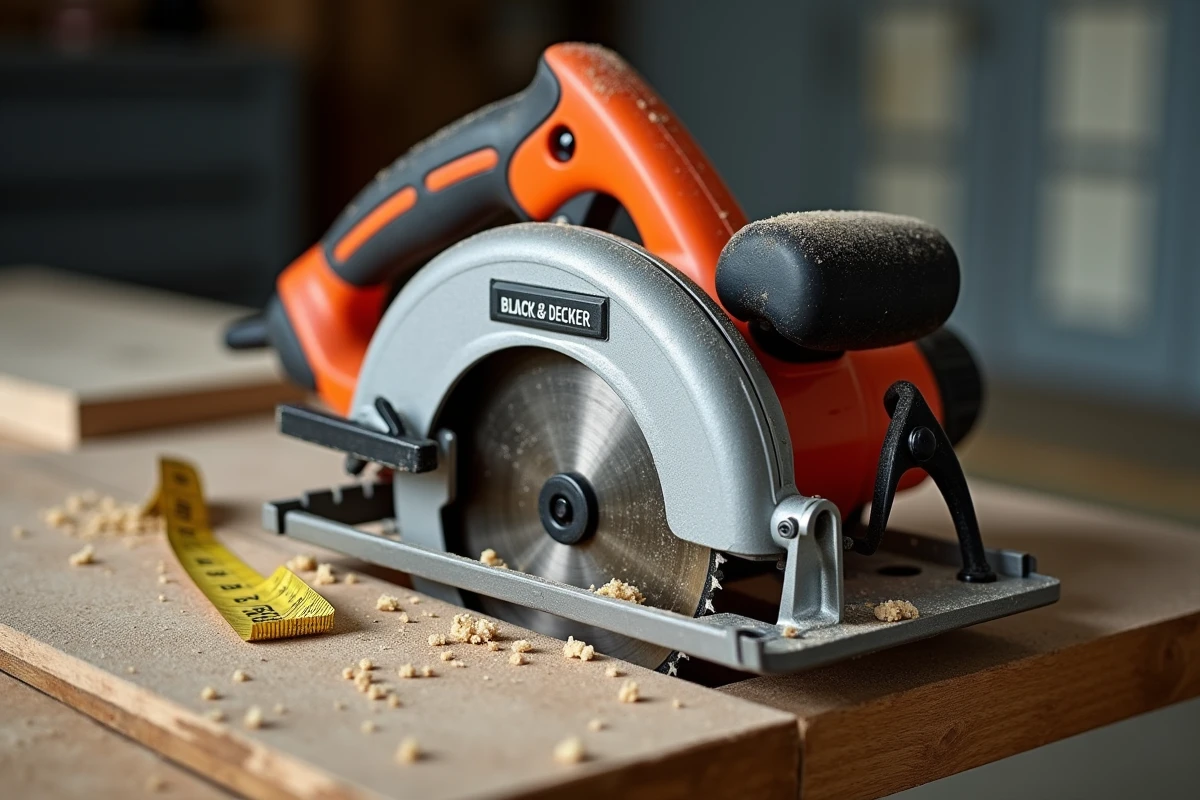
Safety of the CD601 Circular Saw: Limitations to Know Before Purchase
Product sheets highlight the easy adjustment of cutting depth and the parallel guide. They are more discreet about one point: the CD601 does not have an electric motor brake. This device, present on most recent corded circular saws, stops the blade within seconds after releasing the trigger.
Without a motor brake, the blade continues to spin freely for several seconds. This is not a manufacturing defect; it is a design characteristic related to the time it was brought to market. Current mid-range models from Bosch, Makita, or DeWalt now include a quick stop brake and sometimes improved anti-kickback systems.
Safety Features Absent on This Model
- Blade electric brake: the blade stops solely by inertia, requiring a wait before placing the tool down
- Reinforced anti-kickback system: the anti-splinter guard remains basic compared to protections in recent ranges
- LED cutting line illumination: absent, making work less precise in low light conditions
For an occasional DIYer aware of these limitations, the machine remains usable by following basic rules: always wait for the blade to come to a complete stop before setting it down, wear safety glasses, and securely clamp the piece being cut.
Value for Money Against Entry-Level Bosch and Makita Circular Saws
The suggested retail price of the CD601 is around a hundred euros. At this price level, it directly competes with entry-level Bosch circular saws (green range) and some compact Makita models.
Wondering why these competing models sometimes cost only slightly more? The difference rarely lies in raw power. It comes down to three concrete points:
- The motor brake, which enhances daily safety and speeds up the work pace between cuts
- The quality of the base: an aluminum base (common with Bosch and Makita) stays flat longer than a stamped steel base
- The availability of replacement blades: the 170 mm format is less common than the 185 mm used by most current circular saws
The 170 mm blade format reduces the choice of available blades in hardware stores. The 185 mm dominates the shelves, and finding a quality carbide blade in 170 mm sometimes requires ordering online.

Black & Decker CD601 Circular Saw: A Model at the End of Its Commercial Life
Several major French retailers have removed the CD601 from their catalogs. Castorama, for example, has unpublished its product sheet. Black & Decker no longer lists it in its current range, replaced by newer models (CS range or cordless circular saws).
In concrete terms, buying a CD601 today means purchasing a discontinued model. It can still be found on Amazon or with a few online retailers, sometimes in residual stock. After-sales service and the availability of spare parts may pose problems in the medium term.
For Whom This Circular Saw Remains a Relevant Choice
A DIYer who cuts a few boards a year, who already has compatible 170 mm blades, and who is looking for a low-cost corded tool may still find it useful. The CD601 is suitable for occasional work on softwood and panels, but not for regular use or demanding cuts.
For a first circular saw purchase intended to last, directing your budget towards a model from the current Black & Decker, Bosch, or Makita range is more reasonable. The price difference is modest, the gains in safety and cutting comfort are real, and 185 mm blades are widely available.
The CD601 has served many DIYers well for years. Its power-to-price ratio was good at its launch. Today, the market has advanced, and investing a few extra euros opens access to superior protections and cutting comfort.