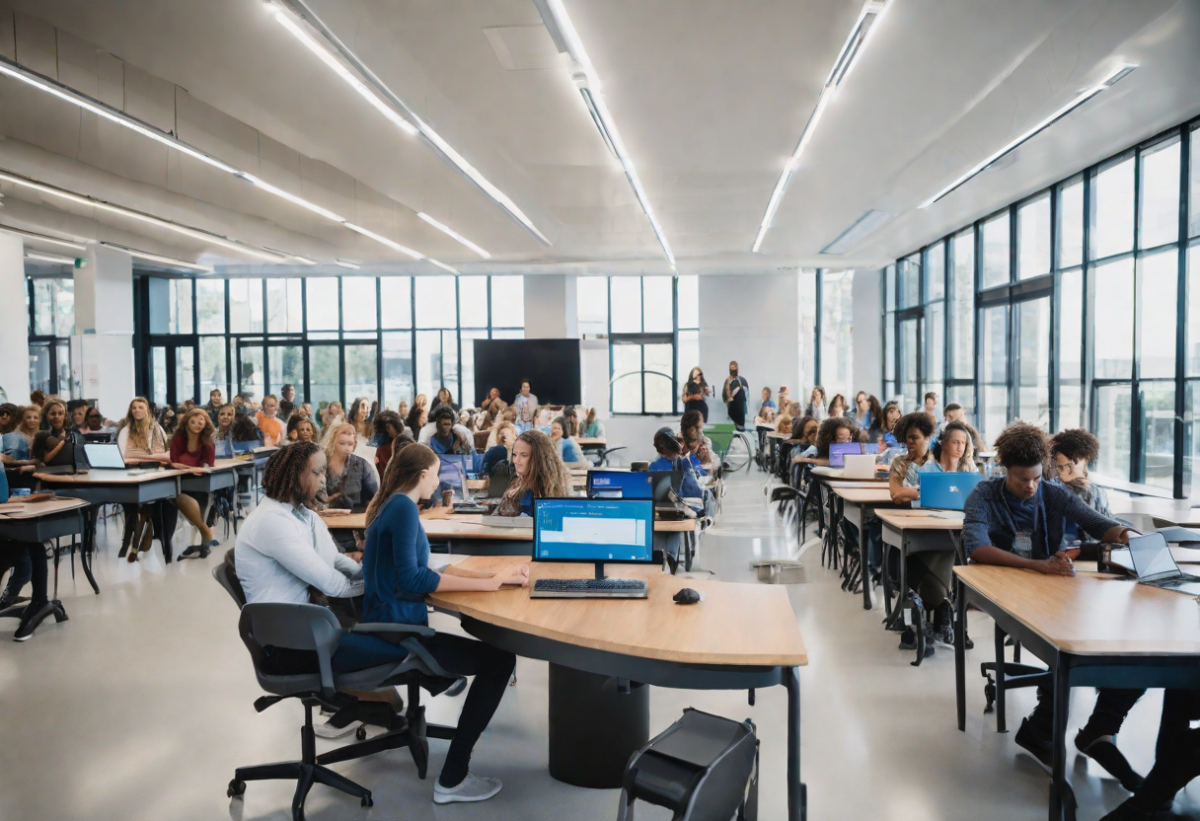
The digitalization of higher education has experienced unprecedented acceleration, pushing engineering schools to integrate digital platforms to manage courses, projects, and assessments. These tools promise to enhance the educational experience by offering flexibility and accessibility. In the face of a growing diversity of solutions, choosing an appropriate platform becomes a strategic consideration. It involves weighing the benefits against potential drawbacks while considering alternatives that may better align with the pedagogical specifics and long-term goals of engineering education institutions.
Advantages and Challenges of Digital Platforms in Engineering Schools
In the landscape of higher education, engineering schools are vigorously embracing digital technologies. E-learning platforms, such as ‘Arel’ from EISTI or ‘Moodle’ used by the École des mines de Douai, open new perspectives for course delivery and knowledge management. The advantage of these systems lies in their ability to centralize digital resources, propose innovative pedagogical scenarios, and foster constant interaction between students and teachers. However, the implementation of such platforms is not without challenges: EISTI has invested no less than 600,000 euros in the development of Arel, while the École des mines de Douai has benefited from funding from Bercy to launch its e-learning initiatives.
The digital school is not an end in itself but a powerful means to serve broader educational objectives. The adoption of these tools must be accompanied by critical reflection on their integration into teaching practices. These platforms must adapt to the specifics of engineering training, where practice and experimentation hold a prominent place. Let us not forget the ENT CESI, which illustrates the possibility of an open architecture adaptable to the varied needs of a school institution.
In the face of web giants like Microsoft, open-source alternatives such as Moodle offer welcome flexibility, allowing schools to tailor the platform to their specific needs without being dependent on a particular vendor. The question then arises as to whether the investment in proprietary solutions, often costly, is justified when less expensive and more flexible options are available. Aware of these issues, the national education sector must move towards sustainable technological choices that consider not only immediate benefits but also long-term implications for engineering schools.

Alternatives to Traditional Digital Platforms and Future Perspectives
Within the ecosystem of engineering schools, pedagogical innovation continues to intensify, leading to profound reflection on alternatives to traditional digital platforms. Business schools, such as EDHEC with ‘Blackboard’, and computer science institutions, exemplified by Supinfo and its ‘Campus Booster’, are broadening the spectrum of digital pedagogical practices. These institutions illustrate the diversity of possible choices in e-learning platforms, between proprietary solutions and internal developments.
Grenoble Ecole de management, after experimenting with various commercial solutions, has decisively turned to Moodle, a platform renowned for its flexibility and open source nature. This transition highlights a trend where institutions, initially attracted by turnkey solutions, gradually recognize the added value of customizable tools that align with their pedagogical specifics.
Supinfo, for its part, uses ‘Campus Booster’ to provide its students with a hybrid learning environment, combining in-person sessions and online modules. This strategy reflects the desire of higher education institutions to adapt to the rhythms and lifestyles of today’s students while responding to the growing demand for more flexible and innovative post-bac training.
As media and information literacy becomes a key skill, these digital platforms prove to be essential vectors for acquiring knowledge in information and communication technologies. Future perspectives thus appear rich in developments, with schools being called to continue exploring innovative solutions that will enrich and diversify the educational pathways offered to students.